Forget-me-not: Mothers and Sons

An installation by Marie Watt commemorating Northwest servicemen and -women killed in Afghanistan and Iraq.

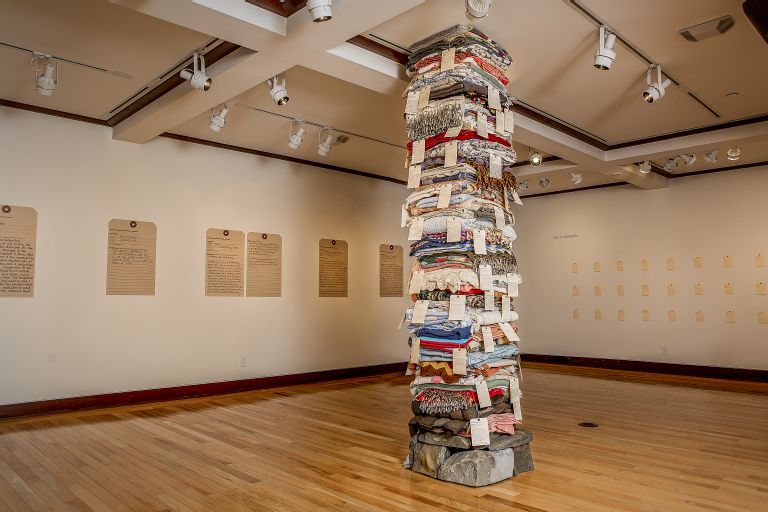
Blanket Stories: Western Door, Salt Sacks, Three Sisters
2017
Reclaimed blankets, manila tags, jingles, stone
Collection of The Rockwell Museum, Corning, NY
Photograph by Willa Vogel

Blanket Stories: Western Door, Salt Sacks, and Three Sisters is a collaboration with The Rockwell Museum and the greater Corning, NY, community. I was commissioned by The Rockwell to gather stories that tether people to place and community. Each story is represented by a textile in this sculpture. The textiles were contributed in response to a call for blankets and their stories from the community including local residents, the greater Finger Lakes region, and friends of The Rockwell. While each blanket in this column represents one person’s story, it also serves as a marker for the collective memory of a larger extended family. Each story communicates the universal nature of our shared human condition and has the potential to unite us.

Western Door

The Seneca Nation of Indians is one of six tribal nations that make up the Haudenosaunee (People of the Longhouse), also known as the Iroquois Confederacy or Six Nations. Historically the western-most tribe of the Haudenosaunee, the Seneca are known as the Keepers of the Western Door. In the context of Corning, NY, and The Rockwell Museum, Western Door acknowledges the long standing presence of Seneca people in Western New York.

Salt Sacks

I was struck by how a humble blanket—made from salt sacks—tells a story about human resourcefulness, a family heirloom, and a regional industry. Salt refineries were a significant part of Western New York’s economy from the late 18th to the early 20th Century. I associate the salt sack blanket story from Helen Sawyer with my mom’s stories of having play clothes made out of repurposed calico-print flour sacks. This salt sack blanket is indicative of the abundance of quilts and their stories collected in this project. They represent the labor—enterprising, creative, and social—of women in Western New York and their immigrant families.

Three Sisters

Three sisters refers to the Iroquois staple foods—Corn (onëö), Beans (osáe’da’), and Squash (o:nyö́hsa’)—that offer sustenance, both nutritional and spiritual, to Iroquois communities. In the Seneca language they are referred to as Diohe’ko which means “our sustainers” or “they sustain us”. Traditionally, they are planted in a way that Corn’s long stalk creates a support for Beans to climb. Beans contribute nutrients and nitrogen to the soil. Squash, planted at the feet of Corn and Beans, has a broad-leaf covering that protects their roots and keeps the soil moist. When grown together, they thrive; when eaten together, they form a complete protein. This is also a metaphor for community and how we are inter-dependent and related. In this sculpture, I have incorporated three tiers of jingles, traditionally used in pow-wow regalia, to acknowledge the Three Sisters.

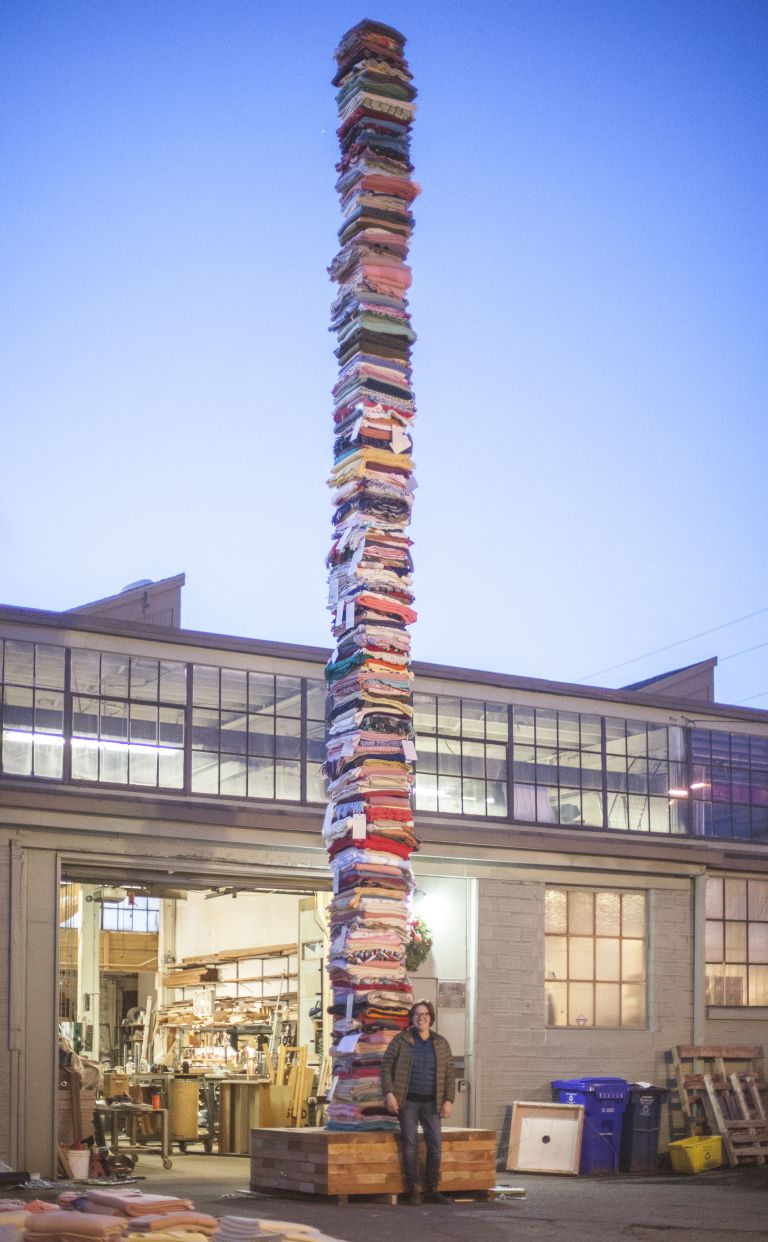
Blanket Stories: Talking Stick, Works Progress, Steward
2016
Talking Stick: 144×11.25×11.25 in.
Steward: 186×23.25×23.25 in.
Salvaged white pine; reclaimed blankets and salvaged fir base
Collection of The High Desert Museum, Bend, OR

This installation is composed of two sculptures that share the same title, Blanket Stories: Talking Stick, Works Progress, Steward. I am interested in how wood and wool blankets, ubiquitous materials in our lives, are touchstones for stories that connect us.

Both sculptures incorporate salvaged timber that was donated to the High Desert Museum in the 1980s. The wood, once part of a train trestle, was used structurally for the working sawmill on the Museum’s grounds, and when this structure was re-engineered, the wood was liberated.

The wooden sculpture is made from a blackened weathered beam that in the carving process revealed itself to be white pine. White pine has been so heavily forested in the West that it’s now considered rare. This beam has been carved to create a wooden column of folded and stacked blankets. In person, you’ll notice that the white pine column is still giving sap. It’s a testimony to this enduring resource, and this beam in particular, likely cut 50–100 years ago, that still gives off sap once carved. The cracks in the wood are called ‘checking’ and are also evidence of the wood behaving like a living and breathing material.

The title references a talking stick, which is a staff or cane used by some Native American tribes in the context of council meetings. Traditionally, the person who holds the staff has permission to speak while others listen; the stick is then passed, giving each person the opportunity to contribute. This practice ensures everyone’s voice is heard. When I was a kid, my mom – an Indian Education Specialist for our local school district – used a talking stick in her storytelling circles. In this context, the talking stick was shared by multi-generational participants – youth, parents, younger siblings, and elders. It was a tool for learning cultural wisdom, sharing stories, and developing public speaking and listening skills. My mom likes to say we have two ears and one mouth, so we’re supposed listen twice as hard.

The second sculpture uses blankets contributed by the local community – Bend, La Pine, Madras, Warm Springs, Portland. The base of the blanket story column comes from fir, also from the Museum’s property. I think of wood, like blankets, as being a storied material. Not only does salvaged wood have a previous history of use, but its rings reveal a lot about the environment in which it grew. I like to think of this use of wood as being in the spirit of the WPA, as so many Works Progress projects drew from both local labor and resources, which in the Pacific Northwest would include timber.

‘Steward’ recognizes the efforts of the region’s earliest inhabitants, caretakers, and preservationists in our communities. In the High Desert Region of Eastern Oregon, it’s appropriate to acknowledge the tribal communities that make up the Confederated Tribes of Warm Springs including the Walla Walla (later called Warm Springs), Wasco, and Paiute Nations. Donald M. Kerr, the conservationist and founding visionary of the High Desert Museum, is also a steward I hoped to evoke and remember. The High Desert Museum, in its mission and programming, shares a model of stewardship for present and future generations.

Blanket Stories: Textile Society, R.R. Stewart, Ancient One
2016
420×24×24 in.
Folded and stacked wool blankets, manila tags, salvaged cedar base
Private collection, Islamabad, Pakistan
Photograph by Melissa Christy

Blanket Stories: Textile Society, R.R. Stewart, Ancient One is a site-specific installation commissioned by the United States Department of State’s office of Art in Embassies for the new embassy in Islamabad.

The project references the historical significance of textiles in the early Muslim world, often characterized as a having been a “textile society.” R.R. Stewart was a New York-born botanist who spent most of his life traveling on foot throughout Pakistan studying the plants of the region. His impressive collection of plant specimens eventually became the basis of the country’s National Herbarium in Islamabad. The term “Ancient One” refers to the early lands and civilizations that have come to be known as Pakistan. It also refers to the Seneca word Uk’sode Gowan, meaning both “great-grandmother” and “ancient one.”

The installation will be a three-story-tall interior sculpture for the new embassy’s atrium, composed of 400 wool or other natural-fiber blankets, collected from the community and assembled into one totem-like column which will enable the intermingling of diverse narratives including American, Pakistani, Native American, Islamic, and many others from around the globe. In a multitude of colors, textures, patterns, and worn bits, the installation will evoke associations and conversations about the rich history of the textile trade as well as the importance of cultural exchange in the Islamic world.

Blanket Stories: Transportation Object, Generous Ones, Trek
2014
18×4×6 ft.
Cast bronze
Collection of Tacoma Art Museum, Tacoma, WA
Photograph by Benjamin Benschneider/OTTO

I am Seneca (Iroquois) and German-Scots. Blankets are a significant part of my familial experience. In my tribe and many others, we give away blankets to mark important life events. Blankets are signifiers of identity in other cultures, as well: a well-known example is the tartans of the Scots. But most blankets are everyday objects. We take them for granted; yet they hold extraordinary histories of use.

With an interest in shared story, blankets in this piece were contributed by members of the greater Tacoma Art Museum community. The project began with an open call for people to contribute blankets and their stories in exchange for a small silkscreen print; the call for blankets also included an opportunity to donate blankets to the Tacoma Rescue Mission (that opportunity still exists and is encouraged; follow this link to contribute).

Blankets came from eleven states and three countries, and have undoubtably crossed more territories and borders than we will ever know. I was struck by how many blankets accompanied individuals and families as they journeyed west; themes of moving, homesteading and immigrating regularly emerged. The representation of blankets that share stories and tributes to servicemen and -women acknowledge Tacoma’s proximity to the Joint Base Lewis-McChord and the significance of veterans to our nation. Handmade – quilted and crocheted – blankets are prominently represented and recognize their storied makers: grandmothers, home-ec students, mothers, sisters and the occasional male. An assortment of baby blankets allude to an infant’s arrival in this world and a deep connection to these woven objects of security. Some blankets have been instrumental in fort-building, comings-of-age, road-tripping, and camping.  Others have nurtured members of the community through illnesses, and many more memorialize loved ones who have passed on.

These stacked blanket forms cross each other, suggesting an “X” – a signature, a term of endearment, the indicator of a name on a treaty, a marker of place and event. An “O” might be at the result from the form, if you could follow it through the walls of the museum. I am drawn to the many associations we have with circles: the first shape a toddler can draw, the wheel of a cart, the moon, the sun, a ball, and so on.

Bronze is a practical material for an outdoor sculpture, but my intention is also conceptual.  Historically, bronze was used to make busts of statesmen and military leaders. Here, it is employed to memorialize stories of everyday lives, as well as the intersection of personal and public remembrance. In this project the corporal object is lost in the casting process – literally incinerated – but is transformed to a permanent marker, a memorial, in its likeness. Remnants of the original object’s life, photos and stories, exist here on this site for further reflection.

The sculpture’s color suggests the connection of water and sky, though its origins are humble as the blankets: it’s standard Safety Blue; used in industrial applications and for highway signage.

Transportation Object is the term used to classify cradleboards at the Smithsonian National Museum of the American Indian. Physically and metaphorically, blankets transport us: they receive us when we are born and they shroud us at death. On the western frontier, this transportation object functioned as regalia, clothing, bedding, and currency.

Generous Ones acknowledges Tacoma’s indigenous inhabitants, the Puyallup and Coast Salish People. The name Puyallup or S’Puyalupubsh means “generous and welcoming behavior to all people (friends and strangers) who enter our lands.” The phrase “Generous Ones” also allows us to reflect and acknowledge those who are generous in our lives.

Trek reflects on slow journeys, as well as the dynamic confluence and exchange that is a part of migrating and settling.

Forget-me-not: Mothers and Sons
2008
10×20×10 ft.
Reclaimed wool blankets, satin binding, thread, steel

Like much of my work, Forget-me-not is about memory, story, and devotion. In part, it stems from my disinclination toward the abstraction of war by the modern media. Television, in particular, does not lend itself to considering individuals: we are taught to refer to our servicemen and women as ‘troops,’ which is a collective term. It wasn’t enough for me. As a mother, I wanted to know more about the sons and daughters from my community who were sacrificing themselves in my name: where they lived, what they liked to do, what kind of people they were. Making these portraits helped me to do that: slowly, with research, consideration, and – within the communities of my studio and sewing circles – discussion.

I am a Seneca woman, a member of a matrilineal society. The Iroquois concept of ‘mother’ is broad, extending from one’s mother through a long line of women: ak’sote ( grandmothers ), ak’sote-kowah ( great-grandmothers ), aunties, sisters, Sky Woman, mentors, friends, leaders. So it was with this view of motherhood in mind – and its dense web of connections extending across generations – that I asked the men I know to suggest women who were significant to them to include in this work. Some of these women were mothers in the physical sense; others gave to our culture in other ways.

The result, I hope, is conversation and communion among individuals: those hung from the web of the circle and those, like you, within it. It is a conversation that I intend to expand. Information was gleaned from public sources; there will be errors, and I welcome correction. I also invite you to contribute to these stories to further illuminate the individuality of these men and women.

I will allow myself some politics in that I wish Forget-me-not was finished. But I fear I will be adding men and women to its web for some time.